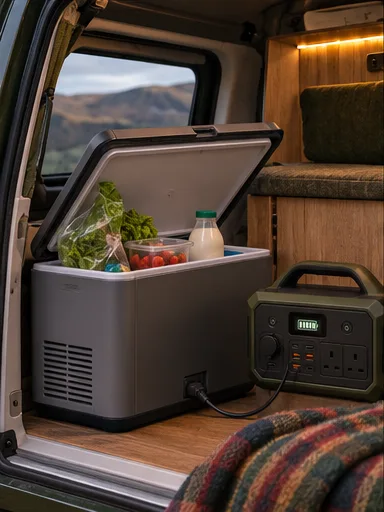
Size a campervan battery for a weekend fridge
Measure a campervan fridge over 24 hours and size a battery for two nights, including conversion losses, other loads and a reserve.
A fridge that uses 280 Wh per day needs about 560 Wh over two days before other loads, backup reserve and any conversion losses.
Measure the fridge in its actual setting
A compressor fridge draws more power when the compressor runs and less when it stops. An instantaneous reading therefore says little about overnight use. Measure 24 hours once the fridge has reached its normal temperature and observe it in the van where it will actually work. Record the outside temperature, ventilation, thermostat setting and how often you open it.
For a mains fridge, use a suitable plug-in energy meter. If you use a portable DC fridge, use the energy reading from equipment specified for that setup or the station’s DC output energy total if it has one. Measure downstream of the port you plan to use. Mains and DC tests can produce different results because the station does different work.
Make a weekend budget with a real reserve
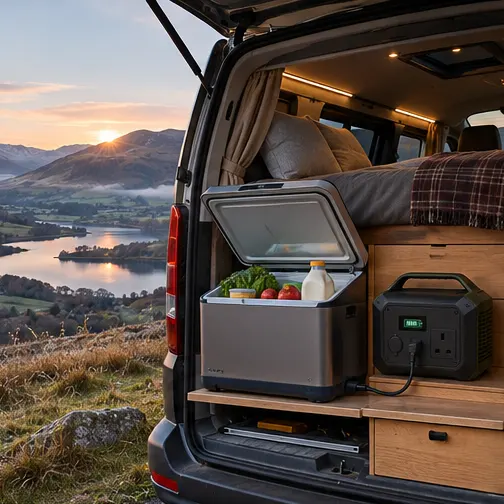
Say the fridge takes 280 Wh each day and lights and phones add 40 Wh. Two days use 640 Wh at the devices. If you want a further 100 Wh at the outputs, plan for 740 Wh of usable output. At an assumed 85% battery-to-load efficiency, the equivalent nominal starting point is roughly 871 Wh. Buying a model close to that number still depends on its measured performance and the temperature it will see.
If you already measured usable battery energy at the outlet, compare your budget directly to that measurement. A charge-percentage reading is useful for seeing trends but is less precise than logging energy over a full cycle. A battery that looks generous on a quiet spring weekend can have little reserve in a hot van with warm food added.
Make sure the fridge stays powered when it matters
Check that the station supports the fridge’s input type and peak draw. For DC, check the approved cable and whether the output shuts itself off at low load. For AC, confirm the compressor’s start-up requirements and choose a station whose manual supports them. A fridge quietly cycling overnight is the test worth doing before you travel.
Keep the fridge vents clear and follow the station maker’s rules for ventilation, charging and transport. Pre-chill the fridge and food from mains before departure if the setup allows it. Bring a thermometer and use food-safety guidance if the fridge warms unexpectedly. The Food Standards Agency’s outage guidance explains how to avoid relying on guesses after cooling stops.
What to check before the second night
Agree a reserve you will keep by late afternoon. If the charge is falling faster than planned, use the campsite hookup or another manufacturer-approved charging method while you still have it available. Solar is useful when you can measure what it contributes. For sizing, treat a forecast of shade or rain as a reason to plan the weekend without guaranteed solar input.