
A practical power-cut plan for a UK home
Plan what to power first in a UK power cut, calculate a realistic backup battery budget and prepare for refrigeration and communications.
Portable power is easiest to use when the devices and cables are already chosen. In Great Britain call 105 to report a power cut. If a cut puts someone in immediate danger, call 999.
Decide what you would actually power first
Imagine the mains goes off at dinner time. You need light, a charged phone and a way to find reliable information. A torch or rechargeable lantern can cover the first hour without setting up an inverter. A phone running on mobile data may be a better use of power than leaving your entire home network running.
If you do need broadband, check which boxes require power. Full-fibre setups can include a separate optical network terminal as well as the router. Backing up only the router may leave you with no connection, and even a powered home setup depends on upstream services. Try the intended setup before a cut and keep an alternative way to contact people.
Put the loads into a simple budget
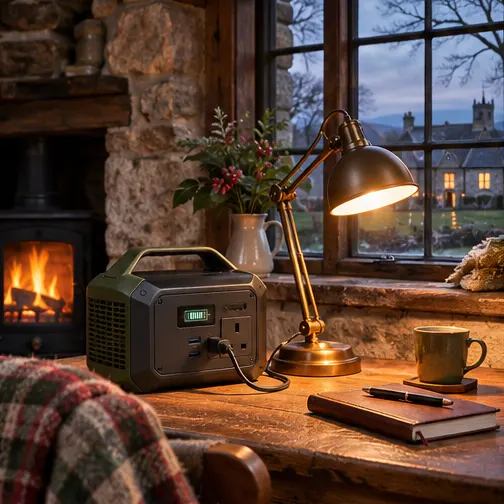
An illustrative household uses a 12 W light and 18 W of network equipment for five hours. Together they use 150 Wh at the outlets. Add 30 Wh for phone charging and the budget reaches 180 Wh. A station with 400 Wh actually available would have roughly 220 Wh left. If 400 Wh is the advertised battery capacity, first allow for outlet losses and the reserve you want to keep.
Time matters as much as watts. Turn off idle AC outputs if the manual allows it. Use the approved USB output for compatible devices. Appliances that make heat can consume a large share of the battery in a few minutes or exceed the output rating entirely. Keep them outside the backup plan unless you have explicitly checked their load and tested the setup.
Plan separately for refrigeration and medical needs
Keep the fridge and freezer closed as much as possible. Follow the Food Standards Agency’s power-cut guidance if cooling is interrupted. If you intend to run refrigeration on a portable station, test the compressor start and measure energy for a representative period using the fridge backup guide.
For powered medical equipment, agree a backup plan with the equipment provider and care team. Check your network operator’s Priority Services Register if applicable. An ordinary consumer power station should only be relied on for that use if the equipment provider confirms suitability and the backup plan covers the outage you could face.
What to check before the next cut
- Note the approved cables, outlets, reserve and normal storage settings.
- Keep a torch and charging cable where you can find them in the dark.
- Run your backup devices as a group and record the battery drop.
- Use only the station’s approved outputs and never feed its power into a household wall socket.
Find your local network operator and outage information through Power Cut 105.